






First, let’s get a big one out of the way: no one ever told me that the single hardest part of this damn Final Fantasy game (specifically, Final Fantasy VII Remake) would be navigating a dark landing without knocking over a suitcase or potted plant. Oh, how many times did I shuffle and sidle? And yet, time and again, I bumped into furniture and woke up my new friend, Aerith, who emerged to hush me and send me back to bed. I was a sheepish mercenary indeed each time I failed at this mundane task. I thought I had signed up for a tactical JRPG full of pretty people and convoluted lore, not for a trial by humiliation in a garden cottage.
I missed the memo that Final Fantasy is very, very silly.
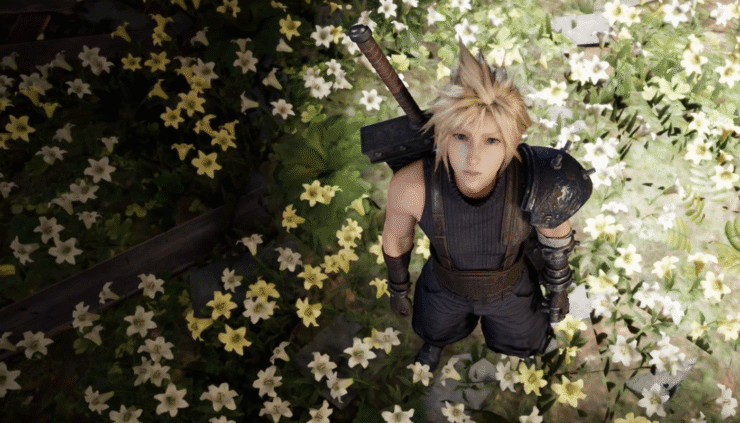
Anyhow. Finally I escaped the landing and descended the stairs, only to find myself confronted by an angry mom warning me to keep away from her daughter. She knew that I, Cloud Strife, while a secret softie, was the exact sort of bad-news-bad-haired ikemen that could only bring her daughter new heartache.
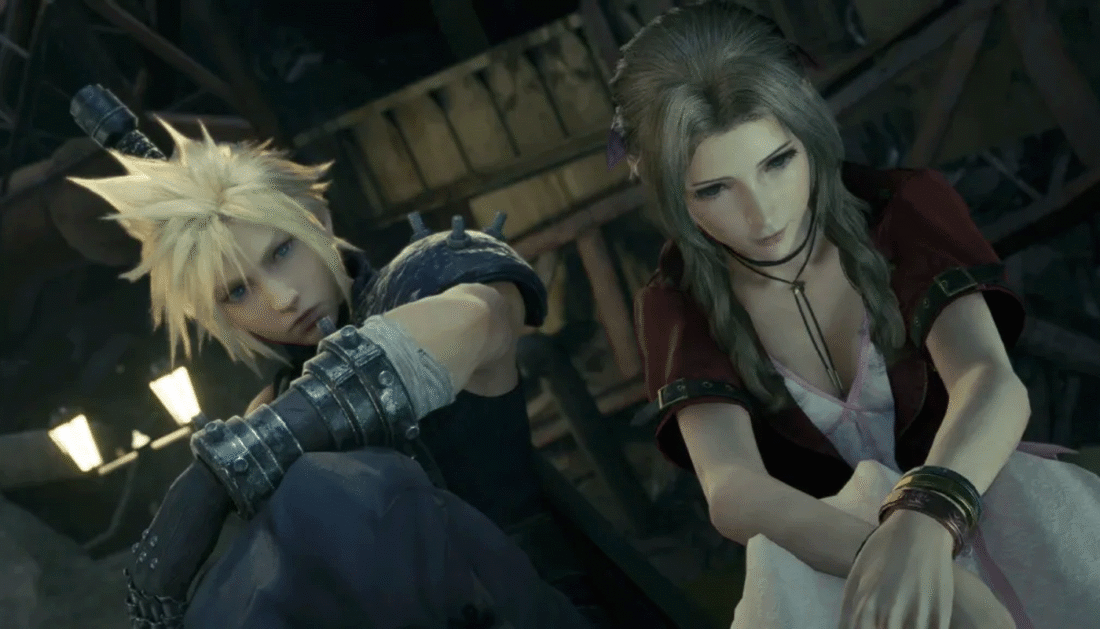
But more fool both of us. Aerith was one step ahead of me, waiting on the path out of the slums, determined to accompany me safely home to Sector 7. No one should walk home alone at night, not even genetically modified super-soldiers. Besides, Aerith is just cool like that.
And see? That’s another thing. No one ever told me that Aerith, a flower-peddling magical young woman with a mischievous sense of humor and maybe a family secret or five, would be at least as interesting a character as the super broody Cloud or the fandom’s eternal true darling, Tifa. Not to slight Tifa; it is not Tifa’s fault that hers is the default design gooners like to compare to “ugly” heroines in American games, rambling incoherently about how Japanese game designers actually know how best to draw women. Essentially, these losers cry out to the heavens, furious that fictional animated women have pores, “Forsooth, she does not give me a boner, and therefore she is a bad character!”
Somehow the same assholes obsessed with Tifa’s admittedly beautiful face and unlikely physique totally fail to mention that she’s also a thoughtful, nuanced character quite apart from what she looks like. A steely-knuckled bartender and local legend, Tifa has made the most of a life beset by poverty and violence and come out the other side owning her own business, hiding revolutionaries in her basement, and helping elderly locals replace the air filters on their shacks.
But for all that Aerith and Tifa are wonderful characters, perhaps the greatest oversight of all is the fact that, in all my years among Final Fantasy fanatics who crotcheted black mage plushies, cosplayed Lightning, and tattooed rectangular swords on their bodies, no one ever told me that it would not be Tifa or Aerith I would fall for in Final Fantasy VII Remake. Instead, I was smitten by Jessie, once a promising actress and now a key agent in an ecoterrorist group.
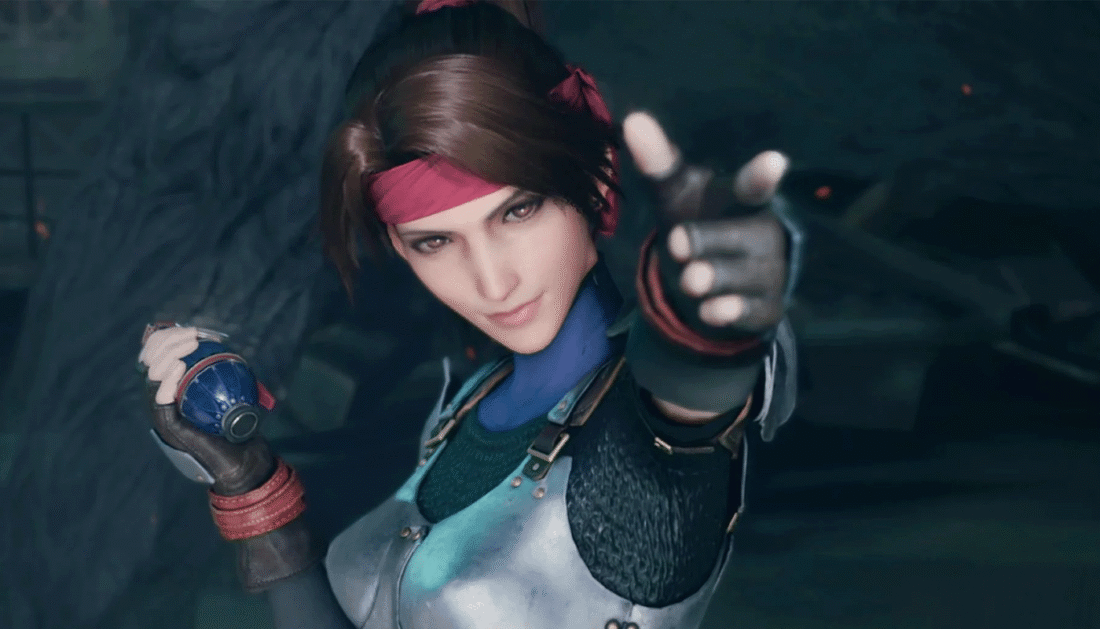
Gods, how I love Jessie. This talented daughter who could have lived comfortably but chose the slums not out of desperation, but because she saw what working for corrupt profiteers had done to her father, comatose after an accident caused by overwork and exhaustion. It is one thing to be born into poverty and vie against it, and another to give up everything and choose it deliberately. Yes, the latter is a privilege, but Jessie is far from the kind of entitled wealthy voyeur immortalized in Pulp’s “Common People.” She’s someone who realizes that the system that benefited her will not benefit society, and she refuses to support it any longer.
Recently, I learned that Jessie has barely any lines in the original game. I am retroactively offended on my best girl’s behalf. But I am also grateful to see how much care the creators have put into fleshing her out in the remake. A remake should always seek to improve on an original, in ways both big and small, even when purists will voice their criticisms.
All this to say, the endless moments of unexpected delight I’ve had while finally playing Final Fantasy in 2026 make me believe there are benefits to having staved off the glimmering, infectious madness of otaku friends over the years who stared at me agog and said, “What do you mean you’ve never played Final Fantasy?!”
The FFVII remakes are the perfect entry point for anyone who, like me, made suppositions about these games based on glancing, sometimes disquieting encounters with a notoriously fractious fandom that appeared, to outsiders, dedicated to objectifying women and worshiping yet another self-serious emo boy with a very big sword.
I’m not even finished playing the first game in the remake trilogy, by the way. None of this is intended to be a review. Instead, consider it a revelation.
The Legacy vs. The Reality
When a franchise has such an enormous reputation in all spheres of geekdom—video games, cosplay, gacha games, trading cards, feature films—it is hard to explain the impact it has on the nerds who’ve only experienced its influence indirectly. In 2018 I made a little pilgrimage to Artnia, an official Square Enix shop and cafe in Shinjuku, so I could buy a Morgana plush for my friend Bridget. At the time I was only loosely familiar with Square Enix, having never yet played Persona but having enjoyed the cult-classic handheld game The World Ends with You. But it did not surprise me at all that the bulk of the building was dedicated to Final Fantasy merchandise. The backroom had swords and intricate figures on display, suspended in glass in a black-tiled room decorated with crystals and LED panels.
Final Fantasy has always been the elephant in the convention center, the one franchise I never delved into despite being told by everyone and their moms that it would change my life. There was no denying its presence or clear sense of identity. I knew Cloud by name, and Tifa too, and when I was in high school my friend Jake brought a portable DVD player on the bus during a marching band trip for the sole purpose of treating newbs to Advent Children, the 2005 Final Fantasy movie.
Advent Children was impressive on a technical front, but it was also damned confusing to anyone who wasn’t already a fan. It gave people like me the impression that this universe might be more trouble than it was worth to invest in, especially in the early aughts when liking anime of any kind could mean a special kind of social death, even among theater kids and book nerds.
Imagine my surprise upon finally playing this game, then. The story is not confusing at all. This is a hero’s journey with familiar archetypes and story beats. There’s a traumatized veteran and a hometown girl, rebels in the slums, and conflict between the greedy rich and the goodhearted poor. There are budding romances and betrayals and fights and death and jokes. Nothing here is new. But Final Fantasy VII Remake delivers all of it with such sleek, admirable conviction…
I have another complaint: I was somehow never informed that Final Fantasy VII is science fantasy, just as full of robots as it is magic and monsters and swords. The primary villainous body is Shinra, a corrupt conglomerate casually destroying the planet. A group of very justified ecoterrorists called Avalanche hire a genetically enhanced Soldier—our boy Cloud—to serve as their muscle on a mission to destroy one of Shinra’s reactors. Cloud, grumpy though he is, proves so useful that they want to keep hiring him on, and he’s just moral enough under his tough, spiky-haired exterior to keep getting coerced into more missions and dozens of acts of community service. He claims to be in it for money, but soon enough Cloud Strife is doing straight volunteer work in addition to mercenary gigs. For all that he tries not to be caught caring about the world, he can’t help himself, especially with a cavalcade of good women calling his bluff and yanking him out of his depressive funks, giving him useful chores and reasons to feel like a person again.
Within minutes of beginning my first playthrough, while Cloud and the gang are trying to explode a reactor, I message my friend Bridget:
Bridget, you never told me your cat is named after the lifeblood of the planet! You nerd.
Yeah. Because my Mako is the planet’s lifeblood!
I cannot disagree. Her cat Mako is a good seal, spotted tummy and all.
This is a game all about saving the planet from humanity’s greed, and how truly evil capitalism is, and how governments collapse when they become indebted to corporations.
These are common enough themes in reality and in modern gaming, sure, but what about when the game came out in the ’90s? Now I have to wonder, in my ignorance: Did Final Fantasy games inspire decades of dystopian and post-apocalyptic games thereafter? Atlus’ Persona, Interplay’s Fallout, the Horizon series, Bioshock, Nier: Automata? Stray?
I made assumptions, for years, that Final Fantasy was more about aesthetics than storytelling. Boy, was I wrong.
This Shit is Queer
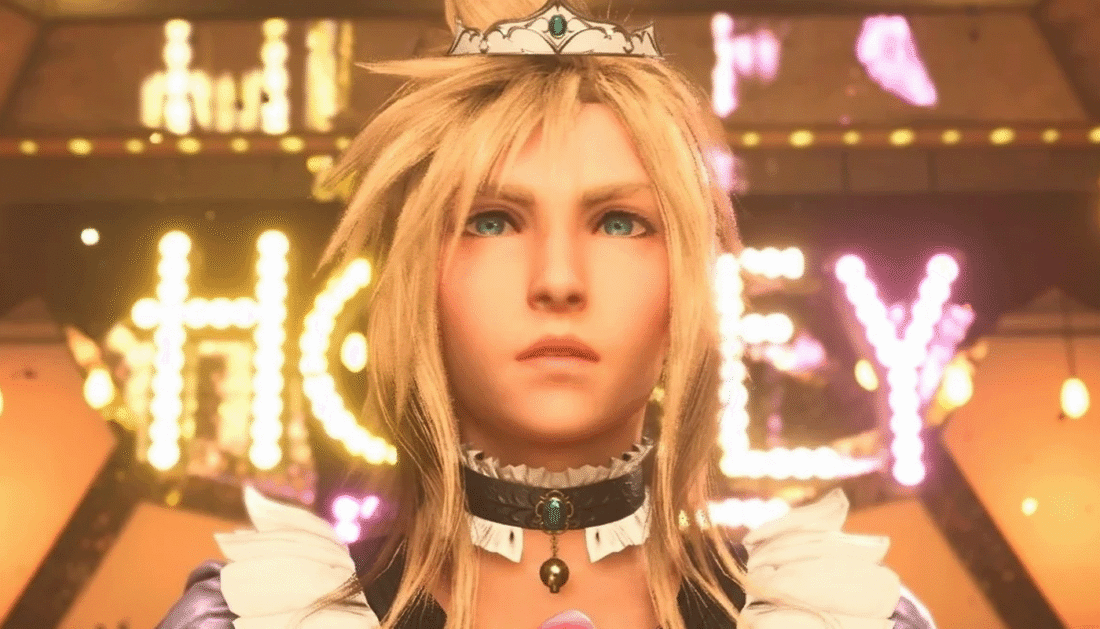
And another thing: No one told me that this game would be gay as hell (complimentary).
Chapter Nine involves Cloud dancing with a wildly flamboyant club owner in order to earn his favor and then undergoing a complete drag makeover, hair extensions and blush and all. I felt like I was watching Drag Race, except instead of retirees or dads being dragged out by the queens, it’s a genetically modified scene kid with social issues.
“There is no heterosexual explanation for that chapter,” Bridget informs me happily.
She is right. And so I say again: Who dared keep all this queer content a secret from me?
Then again, maybe the signs were there all along, even when I knew no better. One of my favorite musicians when I was in college, Owen Pallett, a gay, genderqueer chamberpop violinist and genius composer, won a Polaris prize under the artist name Final Fantasy; they kept the moniker until the threat of a lawsuit inspired a name-change before their first Japanese release. Several of the Cloud cosplayers I know are gay and sapphic as they come. And the high school friend who brought Advent Children onto the bus in the hopes of blowing our minds? He was the first friend I ever knew to come out of the closet.
I wish someone had told me that despite the toxicity that dominates the online discourse, Final Fantasy is queer culture, too.
A Beguiling Dystopia
Now, people did tell me there would be beauty. That is best distilled in the game’s understated moments, those instances when the player gets to exist in the fully-realized settings.
Here are some moments that will stay with me:
Cloud, Tifa, and Barrett shutting off the beacons that illuminate the slums below the floating disc of Midgar, because the city’s shadow prevents sunlight from reaching the poor. Walking on catwalks, feeling genuine vertigo when I dare pan down to look at the shacks sprawled below at sunset. I am reminded of the iconic scene in The Empire Strikes Back when Luke dangles, mangled, from the machinery beneath Cloud City.
Aerith and Cloud hopping across rooftops with a dilapidated church in the background.
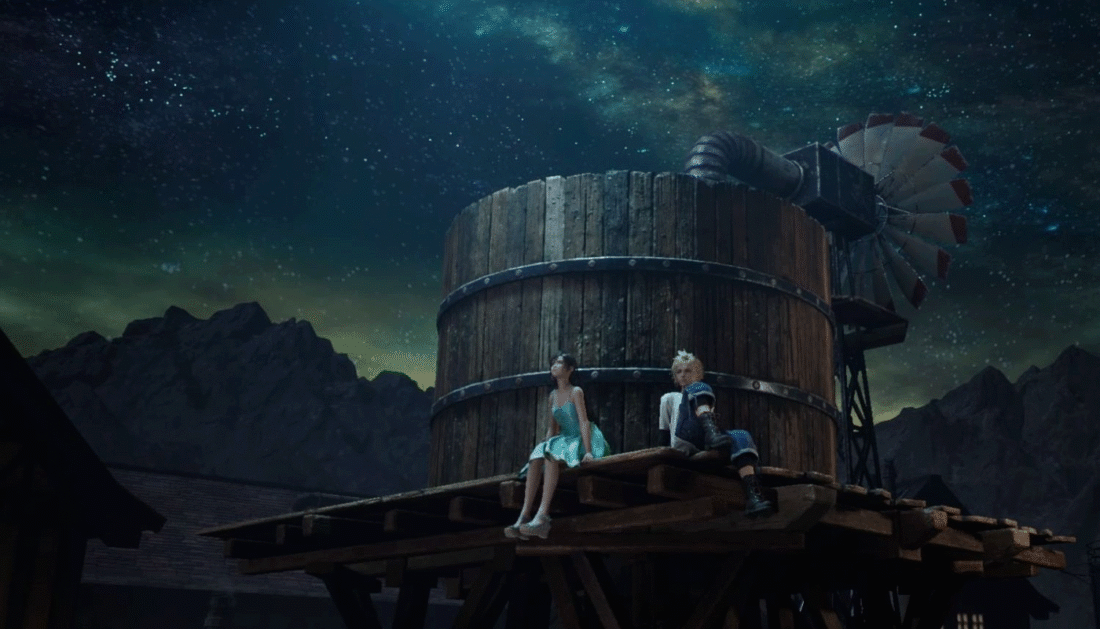
Cloud and Tifa as children, staring up at the stars from their perch on a ramshackle water tower, dreaming of a better future.
Visiting a red-lit massage parlor, where a ruthless businesswoman in a kimono smirks at us from behind the counter and, soon thereafter, deciphers Cloud’s history by crushing his palms in her manicured hands.
Standing in Aerith’s mother’s kitchen, where a pumpkin sits on the counter and dishes wait in the sink and a window overlooks a garden. The decor makes me miss my grandmother and recalls the best Ghibli films, too.
I could go on. This game is cinema.
And if maybe the slums feel a little romanticized, it isn’t for lack of grit. The hodgepodge of streets and piecemeal businesses have been designed with obvious attention to details. There are street cats in the alleyways and wanted posters on the walls. You can listen in on the changing conversations around the neighborhood and learn about cheating husbands and misplaced bets, thoughts on reactor explosions and the price of goods. Old women sell pottery, and bartenders let you buy jazz tracks for your growing collection. Children play on corrugated rusted roofs and build secret hideouts between ramshackle buildings.
You help an old man visit the grave of his dead wife, clearing away the beasties that have made it inaccessible. You select flowers from beds in a beautiful oasis, and they will be used to decorate an orphanage. You travel by train with working commuters and throw darts in bars. You do squats in the gym, overseen by a muscled man whose face is beat for the gods, his eyebrows more impeccable than mine will ever be. You come across tourists from the world above, curious about slum life. And you befriend a cunning would-be Boy Scout who’s interning at the evil conglomerate in order to dismantle it from within. Kids these days.
All these moments are part of your downtime, but all that slice-of-life color contrasts well with fighting demonic houses and bladed robots and other super-soldiers on motorcycles.
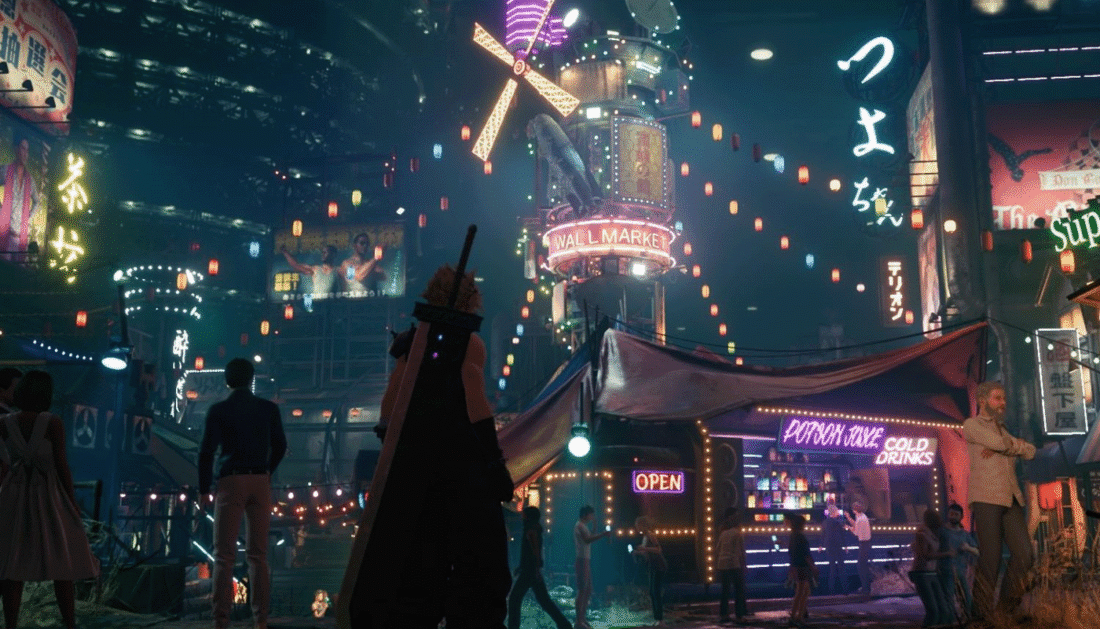
The most impressive setting for me so far is the Vegas of Midgar: Wall Market, in all its sordid neon glory. At one Western-themed brothel, a girl gives you a country song for free because she accidentally bought two copies. In one sketchy alleyway, a man vomits against a wall, looked after by his worried friend. In another, you recognize an exotic dancer in a honeybee outfit as a teacher you met earlier in the day. A man lounges on a settee in an unexpected recreation of the sort of weird crystal shop that seems to exist in every small American town west of Hoover Dam. Wall Market feels dangerous, but fun, with its colosseum battles and faux Chinese palaces and fashionable shops and carts pulled by giant birds. Even in the seediest of places, wonderment abounds.
I am not going to bother saying much about the combat gameplay, because I’m the sort of gamer who kind of sucks at games. I love strategy games and JRPGs; however, Final Fantasy somehow combines the control that comes with choosing moves from a menu with the immediacy of being caught up in battle. The action does not stop while you make your decisions, and the adrenaline I feel directly corresponds to the ATB bars that allow you to unlock better moves mid-fight. I have no stake in the endless controversies that besiege the fandom on this front; I am in this for the storytelling, frankly.
With Apologies to Mr. Strife
The game’s developers have decided, wisely, that the way to bridge the gap between old and new players is to get a little bit metacognitive about the original game’s existence. When a franchise has such an extensive, formidable reputation, it’s easy to rely on nostalgia and wind up making something derivative. But Square Enix is dodging that by implying that the remakes take place in an alternative universe. While players realize it, so do some of the characters—notably the bad guy, Sephiroth. And if we are in another timeline and the villain dislikes his original ending, well, what’s to stop him from hijacking and altering what has long been canon? Suddenly, Final Fantasy can truly reinvent itself.
This idea—that things can and will always change—is essential to this franchise’s longevity.
With all this in mind, I want to extend an apology to Mr. Strife. I want to announce a change of heart and admit I have long misjudged this protagonist.
I remember classmates drawing Cloud in their margins in high school, alongside Sonic and Tails and Link. He always appeared, from the outside looking in, to fall directly into the usual tortured hero trappings. His name is Strife, for crying out loud. But what seems to be fertile ground for a cliché somehow unfolds into a complicated, sympathetic character. While the archetype is old, the elevation is in the details. Cloud struggles with eye contact and social cues, and can hardly ever maintain his stoic facade. His are wavering eyes, not cold ones, and his attempts at feigning apathy always fail. Cloud is terrible when it comes to taking compliments or hearing jokes, not because he thinks of himself as above them, but because those interactions belong to a realm he has been excluded from. This is a guy who essentially signed up for war and came back damaged, but his core kindness remains intact. For all that Cloud Strife would like to pretend that he’s only in it for the money, we soon see him through Tifa’s more generous eyes. There’s hope for Cloud to change for the better—and for the remade games to change for the better too.
No one ever told me I might see myself in Cloud Strife. His stubbornness paired with deep insecurity, his desire to do good while believing he and the world itself are both inherently lost causes.
There’s so much of Final Fantasy VII Remake that I didn’t see coming. I still don’t. I am only on Chapter 10. I know there will be more breathtaking moments, heartbreak and confusion, and very silly hair. I am here for all of it.
This franchise is older than me, so it only took me my whole damn life to finally play Final Fantasy. If you haven’t, I recommend it. I am constantly charmed and surprised by the events unfolding in this bleak—but never, hopeless—dystopian tableau.
If Cloud can overcome his flaws, we can too. We can all learn to high-five our friends, to celebrate our victories, or accept kindness without going into crisis. We can survive our oppressors and make the most of a humble home. And, with practice, we can navigate dark places without giving up and going back to bed.
